What to look for in a Level 3 Pilates qualification – and why we’ve switched to Active IQ
Until early last year, I assumed all awarding bodies were the same. I have since learned that, although the qualification specification is identical—originating from the National Qualifications Framework (CQF)—each provider has its own approach to delivering and assessing it. The resources they offer vary widely, and this, in turn, significantly affects the quality of provision.
YMCA, which Harmonise has always previously used, is a highly reputable and professional awarding body with excellent customer service. They consistently aim to set the bar high. However, the sheer volume of paperwork, along with how it is laid out and explained, has been an ongoing source of unnecessary (in my humble opinion) stress and overwhelm for many. This has always been a source of inner conflict for me.
In Active IQ, I’ve found a highly reputable awarding body whose paperwork is less involved, more straightforward, and more intuitive to follow. This means more time to focus on the practical application of teaching Pilates, which I have always strongly advocated.
It also gives us at Harmonise greater autonomy in how we deliver our training, while giving learners peace of mind that they will still receive the all-important L3 accredited qualification in addition to the Harmonise 200-hour diploma certificate.
I am delighted to announce that all future Level 3 Pilates Teacher Training courses at Harmonise will be run in collaboration with Active IQ.
YMCA and Active IQ are the most reputable awarding bodies, and for good reason. However, there are still big differences in training providers that are delivering L3 courses. Here’s a list of the benefits and what to consider when choosing a provider.
Benefits of an L3 regulated Pilates qualification
- A regulated qualification means there is a 3rd party (awarding body) overseeing and checking that the training provider is meeting the standards set by the awarding body, who is acting on behalf of the National Qualifications Framework (NQF) and is regulated by Ofqual. Non-regulated training providers are not accountable to any external frameworks, syllabuses, or checked by 3rd parties.
- An L3 regulated Pilates qualification is UK Government-approved and recognised, and therefore, internationally recognised.
- An L3 regulated Pilates qualification is CIMPSA endorsed.
- An L3 regulated Pilates qualification is the industry standard and recognised by all insurers.
- An L3 regulated Pilates qualification is equivalent to an L3 BTEC and can contribute to UCAS points.
- All L3 providers of regulated qualifications need to have clear policies and procedures in place and keep records to evidence the fair implementation of qualifications, which helps to protect you as a learner.
- All tutors need to have an L3 award in education and training, all assessors need to have an L3 award in assessing vocational-related achievement, and all internal quality assurers need to have an L4 award in internally quality assuring to ensure high and fair assessment standards.
- The L3 mandatory units are the same for L3 Pilates, L3 Yoga, L3 personal trainer, and L3 reformer Pilates. This means that you don’t need to repeat them if you train in more than one discipline (these are L3 anatomy and physiology, L2 exercise, fitness and health, L2 health and safety, and L2 customer service).
Important considerations when deciding on an L3 regulated Pilates qualification
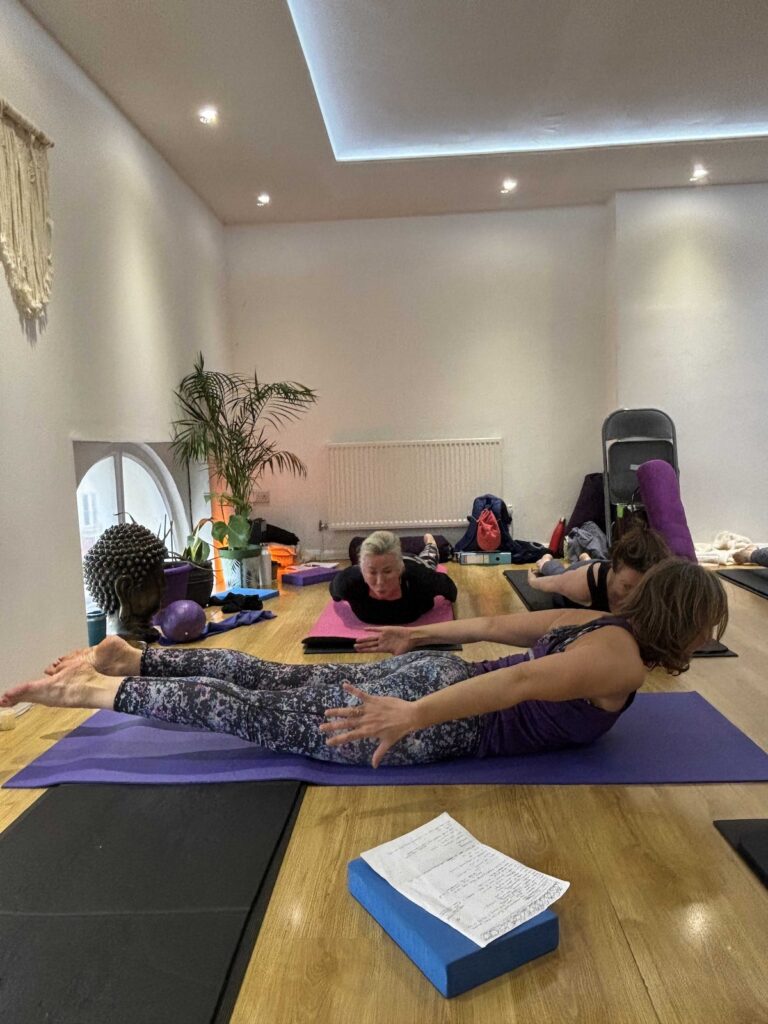
- As long as a tutor holds an L3 Pilates certificate, they can tutor on an L3 course. In theory, this means a brand-new teacher could start tutoring straight away. Don’t be afraid to ask a training provider how much experience the tutor on your course has. At Harmonise, Clare has been teaching for over 25 years, and Stacey has 10 years of teaching experience.
- Many L3 training providers (though not all) are not up to date on current research in anatomy, fascia, and contemporary approaches to Pilates. I have been very impressed with Active IQ’s approach, which appears to be strongly influenced by Body Control. My own training background is with Stott Pilates. These well-established self-regulated training providers offer a modernised interpretation of the classical Pilates method. They tend to offer more authentic, mind-body-focused Pilates than many L3 providers, whose programs are more fitness-based.
I’d recommend asking who your tutor trained with and whether you can do a free trial class to see if their teaching style suits you. Many fitness-industry courses still use strong, outdated language that isn’t helpful.
I completed my reformer training last year and was frequently encouraged to cue clients to “brace” the abdominals, which actively increases downward pressure into the pelvis and can exacerbate pelvic floor dysfunction and prolapse. I was also trained to cue an “aggressive tuck of the tailbone under,” which is unhelpful for people with a posterior pelvic tilt and can lead to over‑compensation and restriction in the diaphragm and breathing. This qualification was CIMSPA-endorsed and delivered by a training provider with excellent reviews.
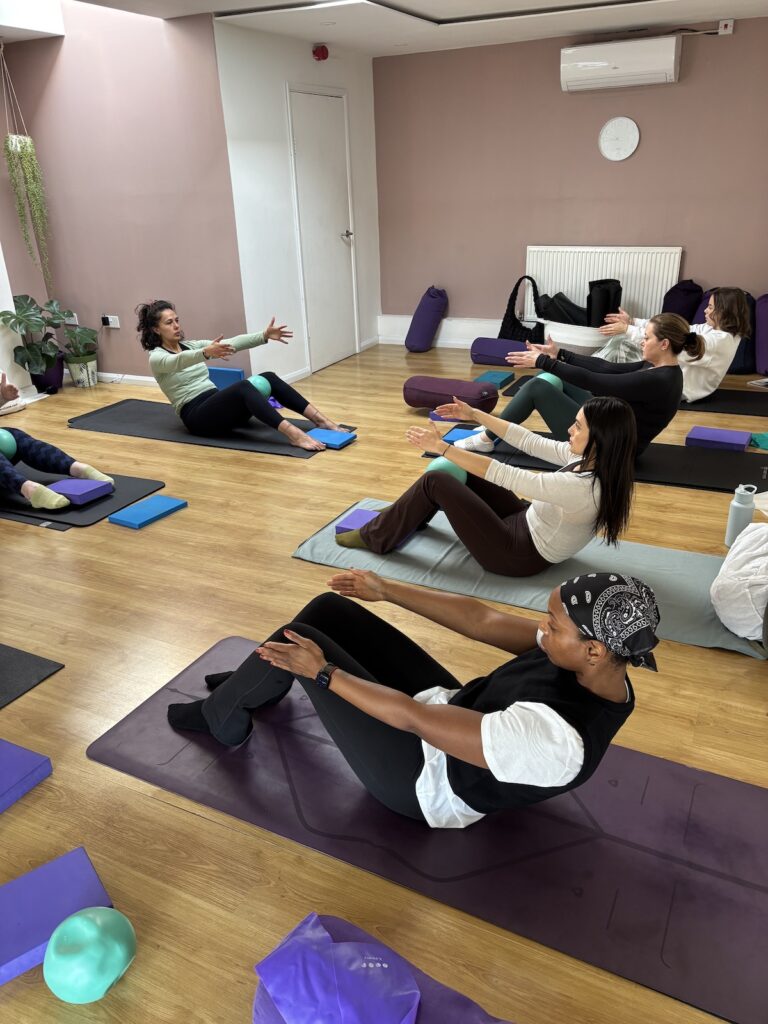
- L3 qualifications can be completed online. My understanding is that some awarding bodies will stipulate that a minimum number of hours must be delivered in real time. However, if you really want to be an effective Pilates teacher, you need to be in a studio, face-to-face, observing breath, posture, movement quality, practising hands-on assists, connecting with fellow trainees, and learning from each other while having the support of experienced teachers to guide you and give you feedback.
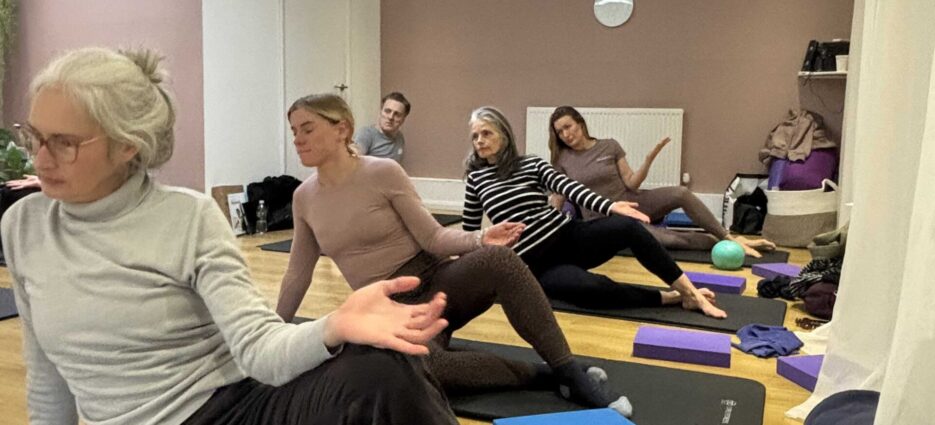
I would highly recommend finding out how many hours a training course includes and how many of those hours are in person. When comparing prices, consider the number of in-person hours, not just the number of days. For example, 11 am – 4 pm is 5 hours, whereas 9 am – 5 pm is 8 hours. This makes a big difference to contact time over a period of days. At Harmonise, our courses include eight full days of in-person training from 9 am – 5 pm, spread over four months, so you have time to digest the material and practise between weekends.
- Due to the various assessments required to comply with L3 regulations, courses often become a “box-ticking” exercise. In many blended courses, learners complete almost everything online, then rush through the practical components in just a couple of days. Much of the course is self-study, which can be stressful, time-consuming and isolating – the opposite of Pilates’ benefits of social connection and stress reduction. It is also common for learners to need multiple attempts to pass assessments, and I believe this structure contributes to a high dropout rate.
During the face-to-face sessions at Harmonise, we explain all the paperwork, and learners can take notes before completing it online. This allows them to ask questions and maximise their chances of passing first time, leaving more time to practise teaching Pilates.
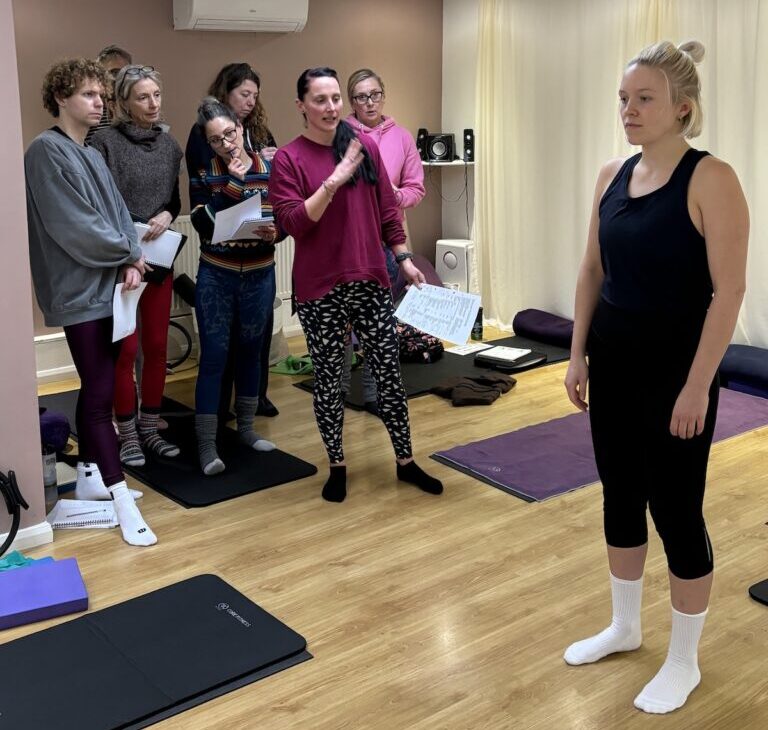
We dedicate a lot of time to the practical application of theory, with extensive teaching practice and individual feedback throughout the course, which builds growth and confidence. All learners complete a mock assessment with feedback. Over the past seven years, we have had a 100% first-time pass rate for our practical assessments. It is always a good idea to ask any training provider what their first-time pass rate is.
We also set ongoing deadlines for accountability and follow-up if a learner falls behind, supporting them to complete the course. Although our drop-out rate is already low, I am confident that the switch from YMCA to Active IQ will reduce it even further, mainly due to the reduced volume of paperwork. I intend to achieve a 100% completion rate, even if life circumstances mean some learners need to finish at a later date.
- The L3 Anatomy and Physiology assessment is a standard exam taken by fitness instructors, personal trainers, Pilates teachers, and yoga teachers. It is usually taught as a separate subject rather than being applied directly to Pilates. Without practical application, the content can be hard to understand, digest and relate to in a real teaching context. Many training providers leave learners to self-study for this assessment. I have heard of many cases where learners have had to re-take their assessments two, three, even up to eight times, on one occasion. This approach may train learners how to pass a multiple-choice paper, but it does not support them in applying the theory to Pilates.
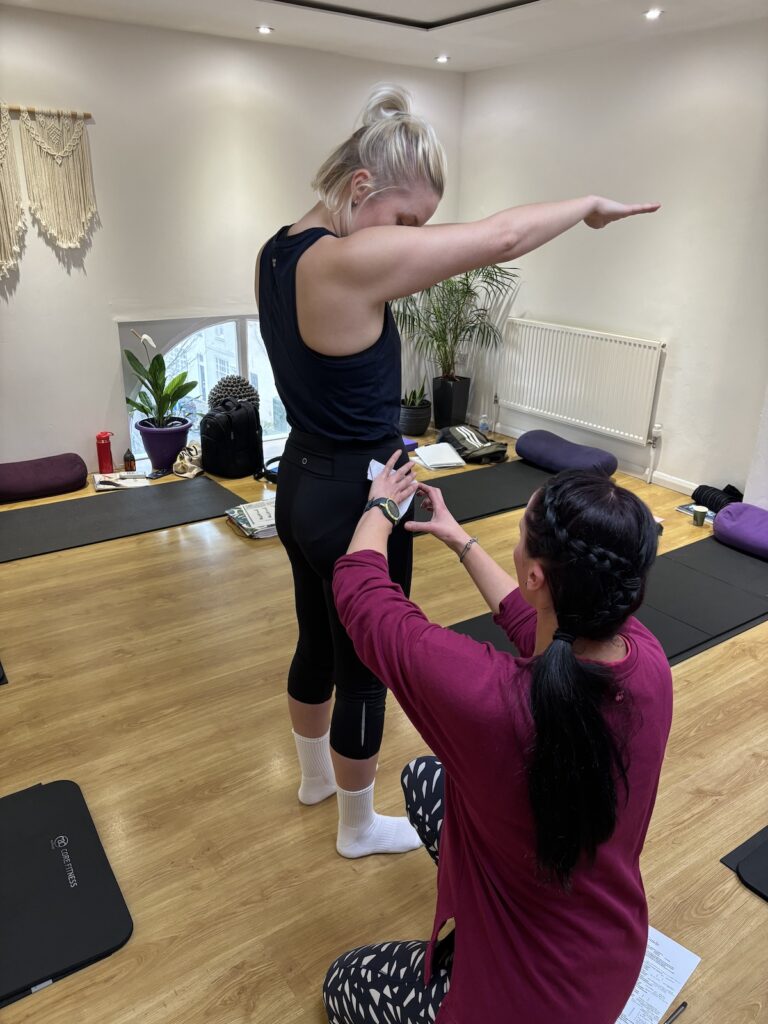
At Harmonise, we provide a wide range of materials to help you pass your anatomy exam and understand how the theory applies practically to Pilates. In person, we then embody the relevant theory to bring the anatomy to life. You’ll have access to our library of support videos, with lifetime access. We are proud to have a 98% first-time pass rate. When comparing courses, I recommend asking any potential training provider what their first-time pass rate is – for both theory and practical assessments.
- Depending on the awarding body, an L3 training provider may cover only a small range of exercises – just enough for you to pass your practical assessment – while repeatedly drilling you on how to teach a few select movements. Although this can help you pass, it may leave you feeling limited in the number of exercises you are confident teaching in the real world.
At Harmonise, we teach a wide range of exercises, including all 34 of the original Pilates exercises. These are part of the YMCA syllabus, but not mandatory with Active IQ. While it is a lot to cover, it means you graduate with the full repertoire, along with modifications and adaptations, in your toolbox. This allows you to be more creative with your sequencing as you grow and evolve as a Pilates teacher. All of our in-person content is recorded and made available online with lifetime access, so you can keep revisiting the exercises as you progress.
Like Harmonise, some excellent L3 providers are offering regulated Pilates training courses. However, many of these are smaller, independent organisations founded by long-standing professionals with a genuine passion for training others to teach authentic Pilates and succeed in the field.
With the recent surge in popularity of mat, reformer, and hot Pilates, many new training providers are entering the market. My strong advice is to research thoroughly before deciding where to train. Investing a little more upfront often means higher-quality training, so you feel confident to teach and start earning as soon as you graduate.
We are now taking bookings for our September Pilates Teacher Training course. As soon as you register, you can begin working towards your qualification with our pre-course learning materials.
If you would like to arrange a free trial class with our tutor at Revitalise, where the training takes place, or schedule a call to ask any questions and find out more, please e-mail me at clare@harmonisetrainingacademy.com.
You can also follow this link to receive more information and access a couple of videos you can take part in at home.
Article by: Claire Francis


